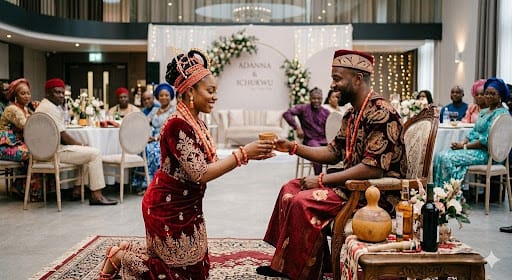
In Igbo culture, marriage is not something that simply happens between two people. It is something that must be seen, acknowledged, and witnessed by family, by community, and by tradition. Igbo traditional marriage, often referred to as Igba Nkwu, is not built only on structured stages, but on recognition, participation, and symbolic acts that affirm a union publicly and culturally. For Igbo couples in the diaspora, this ceremony carries even more weight. Because when you are far from home, being seen in your culture becomes just as important as practicing it.
Understanding Igbo Traditional Marriage: More Than a Ceremony
Unlike highly sequential systems, Igbo traditional marriage flows through key symbolic moments rather than rigidly segmented stages. Each moment answers an important cultural question:
Has the family accepted this union? Has the bride publicly affirmed her choice? Has the community witnessed and validated this marriage?
The ceremony is not just performed. It is confirmed step by step, in front of people who matter.
1. Introduction and Family Agreement: Where Intention Is Established
Before the public ceremony, there are private family meetings.
Families meet, ask questions, and establish alignment Backgrounds are understood Intentions are made clear
This stage may not always be visible during the wedding day, but it is foundational.
Cultural meaning:
Marriage begins with knowing not assumptions, not appearances, but clarity between families.
2. Bride Price (Ime Ego): Honour, Not Transaction
The bride price process in Igbo culture is deeply symbolic.
Lists are presented Items are gathered and presented Families engage in respectful dialogue
There may be negotiation, but the tone is intentional — not confrontational.
Cultural meaning:
It is not about buying a bride. It is about honouring her upbringing, her family, and her value.
3. Igba Nkwu: The Moment That Defines Everything
This is the heart of the ceremony. The moment many people remember. The bride enters often beautifully dressed, sometimes with her bridal train. But she does not go straight to the groom. She searches. Sometimes playfully. Sometimes slowly. Sometimes with suspense. And then she finds him. She kneels. She offers him a drink (palm wine). He accepts. The room shifts. Because in that moment, everything becomes clear.
Cultural meaning:
This is the bride’s public declaration: “This is the man I choose.” It is personal, but witnessed. Emotional, but symbolic.
4. Community Witnessing: Marriage as a Public Affirmation
In Igbo culture, marriage is not hidden. It is not quiet. It is affirmed in front of people; family, extended relatives, community members.
Cheers, applause, and celebration follow the palm wine moment Families acknowledge the union The couple is no longer just a couple, they are now recognised
Cultural meaning:
A marriage is strengthened when it is witnessed. The community becomes part of its foundation.
5. Celebration: Joy as Collective Participation
Igbo traditional weddings are vibrant, expressive, and full of life.
Music fills the space Guests participate actively Dance becomes a shared experience
But beneath the celebration is something deeper: A sense of collective joy not just for the couple, but for both families.
Cultural meaning:
Marriage is not just a union to observe, it is a union to celebrate together.
The Cultural Philosophy Behind Igbo Traditional Marriage
At its core, Igbo traditional marriage is built on:
Recognition — the union must be seen and affirmed Choice — the bride’s role is visible and central Community — marriage belongs to more than the couple Symbolism — meaning is expressed through action, not just words This is why Igbo weddings feel:
expressive participatory emotionally visible
Igbo Traditional Marriage in the Diaspora
For Igbo couples abroad, certain challenges emerge:
Guests may not fully understand the symbolism The palm wine moment may be rushed or misunderstood Cultural context can be lost in modern venues The depth behind each act may not be explained
And when meaning is lost, the ceremony risks becoming a performance. But when meaning is preserved, the ceremony becomes powerful even across borders.
Where Cultural Guides Fit in Igbo Weddings
Unlike Yoruba weddings with a central Alaga figure, Igbo traditional weddings are guided more collectively.
Family elders play key roles MCs may help coordinate flow Cultural anchors (often experienced family members or coordinators) help maintain structure
But the need remains the same: Someone must ensure that meaning is not lost. Especially in diaspora weddings, where explanation becomes just as important as execution.
Conclusion: A Marriage That Must Be Seen to Be Complete
Igbo traditional marriage is not defined by how perfectly it is performed. It is defined by how clearly it is understood, witnessed, and affirmed. Every symbolic act from bride price to palm wine carries meaning that goes beyond the moment. And for couples in the diaspora, preserving that meaning is not just about culture. It is about identity. Because when a marriage is seen, acknowledged, and celebrated in its full cultural depth… It becomes more than a ceremony. It becomes a story carried forward.
FAQ: Igbo Traditional Marriage (Igba Nkwu)
1. What is Igba Nkwu?
Igba Nkwu is the Igbo traditional wedding ceremony where the bride publicly identifies and serves palm wine to her groom, symbolising her choice and the confirmation of the marriage.
2. What is the significance of the palm wine ceremony?
It is the defining moment of the wedding. When the groom accepts the drink, the marriage is publicly affirmed and recognised by both families and the community.
3. Is bride price in Igbo culture a payment?
No. Bride price (Ime Ego) is symbolic. It represents honour, respect, and appreciation for the bride and her family.
4. Why is community important in Igbo traditional marriage?
Marriage is seen as a communal union. The presence and witnessing of family and community members strengthen and validate the relationship.
5. Can Igbo traditional weddings be adapted in the diaspora?
Yes, but the key symbolic moments — especially the palm wine rite — are usually preserved to maintain cultural meaning.
6. Who leads an Igbo traditional wedding ceremony?
There is no single figure like the Alaga. Instead, elders, family members, and coordinators collectively guide the ceremony and ensure traditions are followed.
Final Thoughts: What It Means to Be Seen
Igbo traditional marriage is not just a ceremony that is performed. It is a union that must be seen, acknowledged, and affirmed by family, by community, and by culture. From the early family agreements to the bride price, and most powerfully, the palm wine moment, every stage carries meaning that goes beyond the surface. It is not just about what is done. It is about what is confirmed. And in the diaspora, where distance can quietly weaken cultural understanding, these moments become even more important. Because when the meaning behind the ceremony is lost, the experience becomes lighter. But when it is preserved, the ceremony becomes something deeper, something rooted. A reminder of who you are, where you come from, and the community that stands behind your union.
NDH CTA
Planning an Igbo traditional wedding in the diaspora? At NDH, we help you find trusted Nigerian vendors who understand the depth, symbolism, and flow of traditional weddings from: event and wedding planners and MCs to photographers and cultural coordinators.
👉 Find • Connect • Book trusted vendors for your traditional wedding on NDH Because your wedding is not just an event. It is a culture to seen, honoured, and remembered.